Paris wasn’t just a city Americans visited – it was where American independence was born. Benjamin Franklin came to Paris in 1776 to convince France to bankroll the Revolution. Thomas Jefferson helped shape the young nation’s vision as ambassador to France. Lafayette chose to be buried in Parisian soil mixed with earth from Bunker Hill.
This guide traces the key locations related to American independence in Paris, from Franklin’s diplomatic missions to the Treaty of Paris – the moment Britain formally recognized American independence. After 15 years of living in Paris, I’ve mapped these sites so you can walk in the footsteps of the Founding Fathers in Paris.
Last update: September 2026
The American Revolution Comes to Paris
When thirteen American colonies declared independence from Britain in 1776, they faced an impossible problem: they couldn’t win a war against the world’s most powerful military without help. That help came from France.
France had its own reasons. Britain was France’s rival, and weakening British power meant strengthening French influence. So, in 1778, France officially entered the war on America’s side, sending money, ships, soldiers, and supplies that proved decisive to the American victory.
But the war wasn’t won on the battlefield alone – it was negotiated in Paris. American diplomats traveled between Paris and the Palace of Versailles to negotiate these crucial alliances and ultimately sign the Treaty of Paris (September 3, 1783), which recognized American independence as that of a sovereign nation. Paris became the diplomatic birthplace of the United States.
Benjamin Franklin Arrives to Secure French Support
Square Yorktown, Paris 16
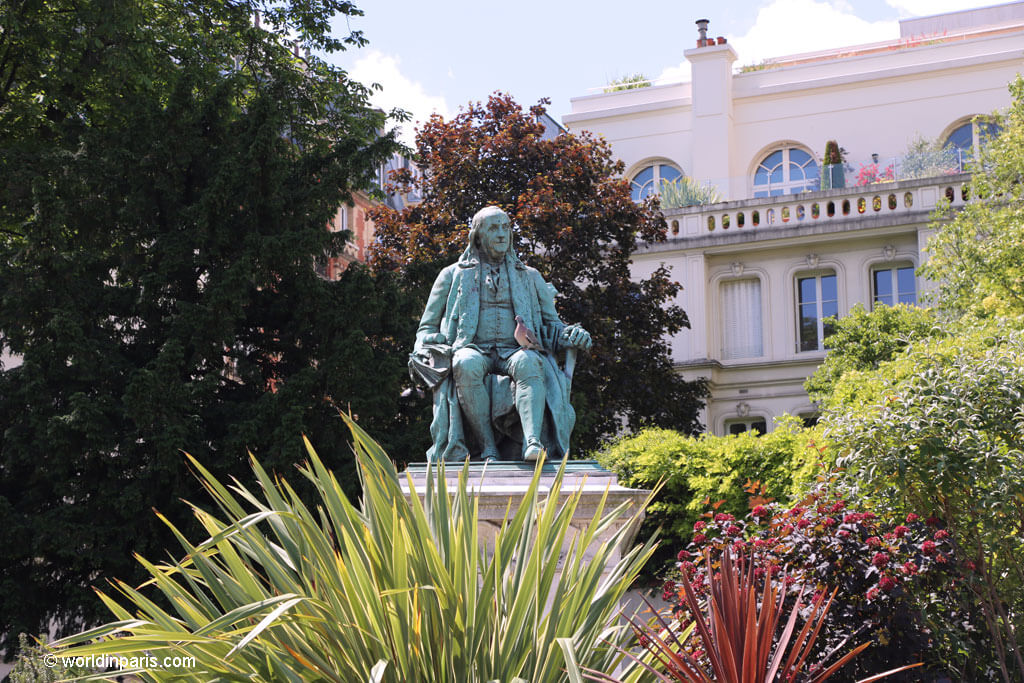
Benjamin Franklin came to Paris in 1776 to call on the French to support the Americans in the War of Independence.
Admired by the Parisian scientific and literary community, Franklin was seen as the embodiment of the Enlightenment’s humanist values. At a French Academy meeting, Franklin and Voltaire befriended and kissed publicly to express their mutual admiration publicly.
Franklin remained in Paris until 1785, and in 1783, he signed the peace treaty, which marked the act of independence for the United States. He was so beloved in Paris that upon his death in 1790, the French National Assembly observed three days of mourning. This was the first time a political institution honored an “ordinary citizen” from another country.
Benjamin Franklin’s Statue at Square Yorktown is a copy of a statue in Philadelphia, U.S. On the pedestal, two bas-reliefs by Frédéric Brou show, on one side, Benjamin Franklin’s reception at the Court of Versailles in 1778 and, on the other side, the signing of the Treaty of Paris in 1783.
Treaty of Paris (1783) – American Independence Recognized
56 Rue Jacob, Paris 6
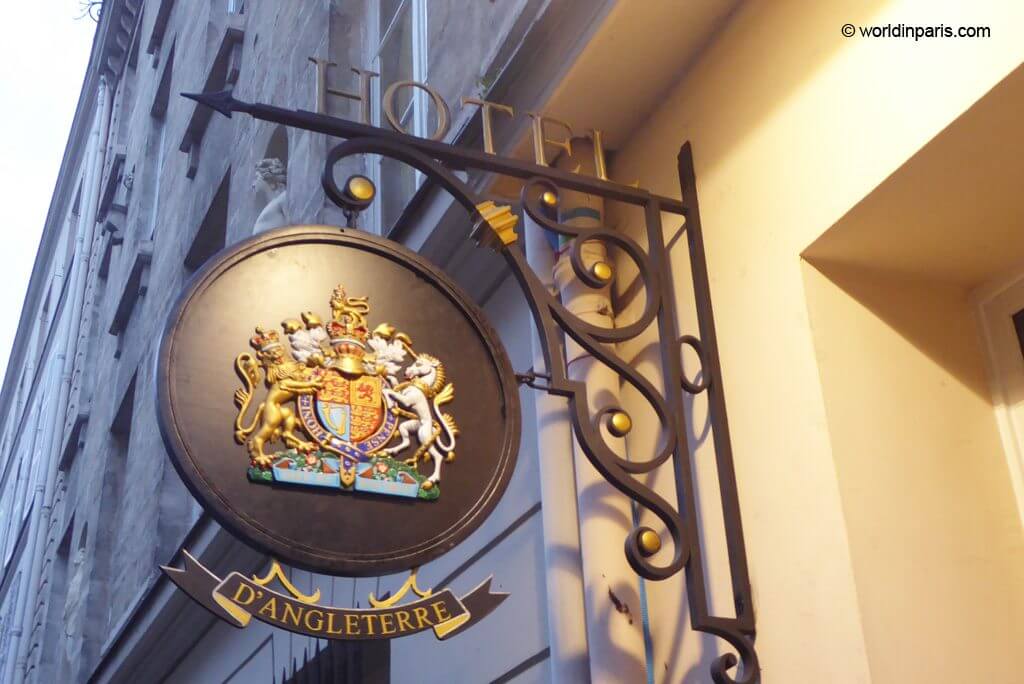
The Hotel d’Anglaterre is one of the most important American Independence sites in Paris. L’Hôtel d’Angleterre hosted the former Embassy of England (hence its name) during the preparation of the Treaty of Paris.
With the Treaty of Paris, signed on September 3, 1783, England recognized the independence of the United States of America.
The Treaty was signed at Hotel d’York (56 rue Jacob) because Benjamin Franklin refused to sign it on English soil.
The plaque commemorating the event is written in French and reads: “In this building, formerly the York Hotel, on September 3, 1783, David Hartley, in the name of the King of England, Benjamin Franklin, John Jay, John Adams, in the name of the United States of America, signed the definitive treaty of peace recognizing the independence of the United States.”
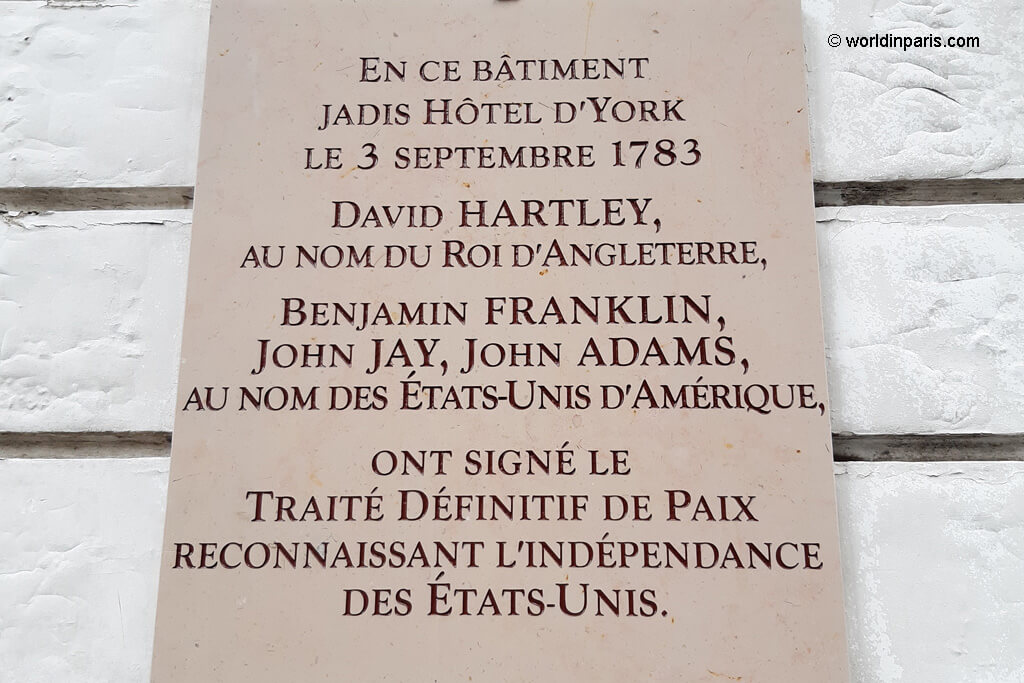
Today, 56 rue Jacob is no longer Hotel d’York but serves as an administration building for Sciences Po, one of France’s premier universities and the alma mater of many of the French elite.
Hotel d’Angleterre (44 Rue Jacob, Paris 6) later became a tourist hotel (with the name of Hotel Jacob and then Hotel d’Angleterre again), quite popular amongst many American celebrities. The Hemingways, for example, spent their first nights in Paris in Hotel d’Angleterre, room #14 (you can read more on my Hemingway’s Paris walking tour).
Thomas Jefferson – Ambassador after Independence
Passerelle Léopold-Sédar-Senghor, Paris 7
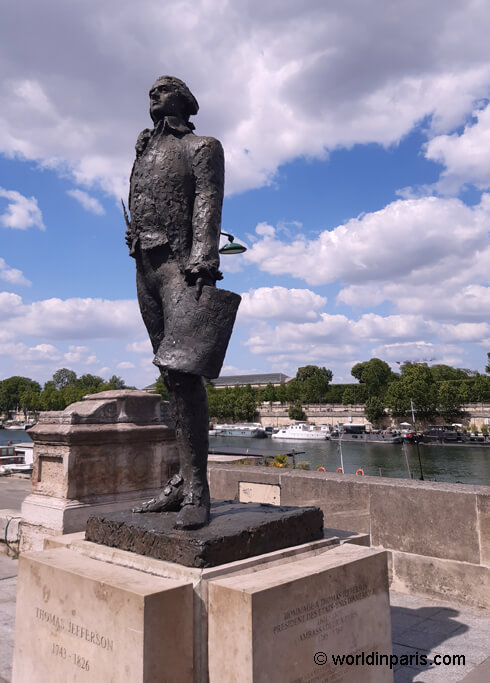
At the end of the Léopold-Sédar-Senghor footbridge, on the Anatole France quay, sits a majestic statue of Thomas Jefferson (1743-1826), the most Parisian of the Americans.
Thomas Jefferson was, in fact, the ambassador of the United States to France from 1785 to 1789. He was the third president of the United States (1801-1809) and one of the most eminent Founding Fathers. Jefferson notably distinguished himself by purchasing Louisiana from France for a mouthful of bread. Jefferson didn’t hesitate to declare, “Each man of culture has two homelands: his own and France.” For Parisians, a quote like this deserves a magnificent statue!
The Statue was inaugurated on 4 July 2004. It was funded by the Florence Gould Foundation, which also participated in restoring the Statue of Liberty on Ile aux Cygnes.
In Paris, Thomas Jefferson enjoyed wandering around the city. An architecture lover, he admired the Hotel de Salm (today Musée de la Légion d’Honneur). Jefferson sketched the building many times, trying to find inspiration for his estate home in Monticello, Virginia. Jefferson’s Statue is pictured facing this building and holding a drawing of Monticello’s first project.
Lafayette’s Tomb in Paris
35 Rue de Picpus, Paris 12
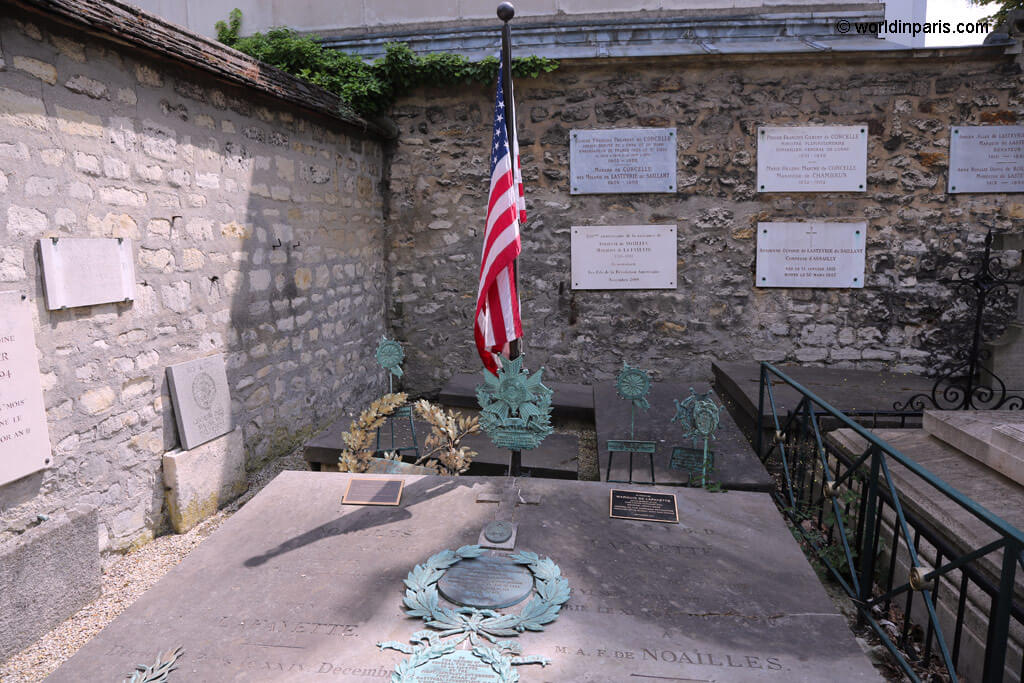
Picpus Cemetery is the final resting place of 1,306 headless bodies who lost their lives at the guillotine set up in the former Place du Trône-Renversé (now called Place de la Nation). Today, Picpus is a private cemetery, and only descendants of those victims can be buried there.
In this cemetery, we can find the tomb of Marquis de Lafayette. He chose to rest eternally with his wife, a descendant of the guillotine victims.
Marquis de Lafayette (1757-1834) was a Frenchman who fought in the American Revolutionary War under George Washington. In the French Revolution, he was part of the National Assembly and drafted the Déclaration des Droits de l’Homme et du Citoyen (Declaration of the Rights of Man and the Citizen). He outlived both Revolutions (just barely) and dedicated his last years to traveling widely as a statesman. He died in Paris in 1834 and was buried at the Cimetière de Picpus under soil from Bunker Hill in Boston – where the famous battle of Bunker Hill was fought.
Lafayette’s tomb is a special place for Americans, and an American flag permanently marks the Marquis’ grave. Marquis de Lafayette became an honorary citizen of the United States in 2002 for his exceptional merits. Until today, only eight foreign people have been so honored.
Every year, on 4 July, a small ceremony is held at the foot of Lafayette’s tomb, attended by the United States’ leading authorities in France.
George Washington Equestrian Statue
Place d’Iéna, 75016 Paris
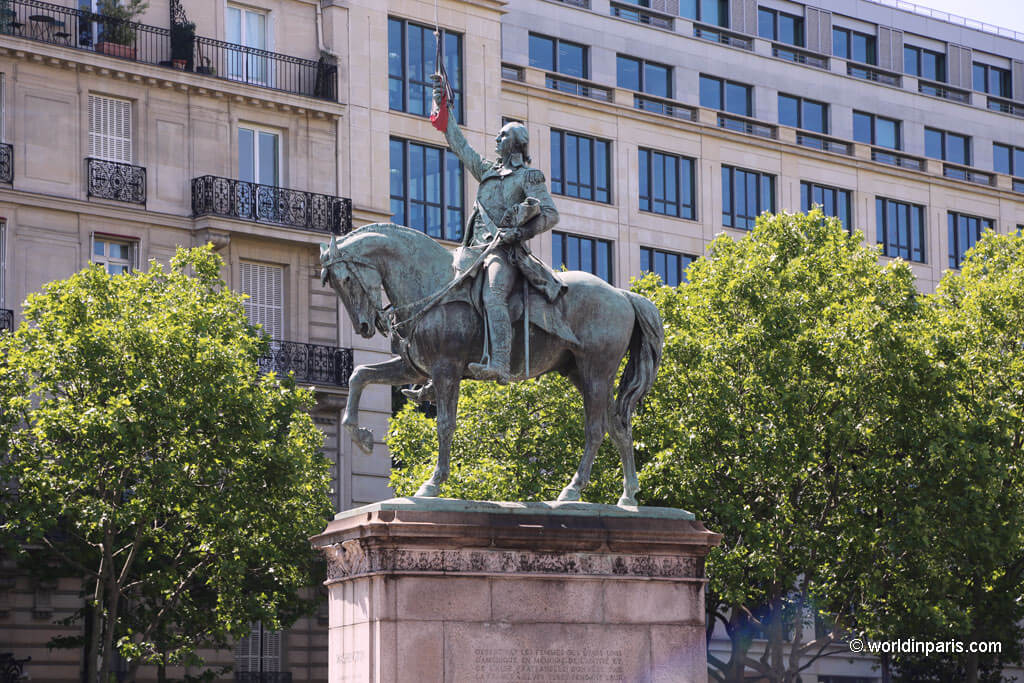
George Washington (1732 – 1799) was the founding father of the United States and served as its first president from 1789 to 1797.
Appointed Commanding General of the Continental Army (1775 – 1783), he commanded American forces, allied with France, in the defeat and surrender of the British during the Siege of Yorktown. He resigned his commission after the Treaty of Paris in 1783.
Washington played a crucial role in adopting and ratifying the American Constitution and was then elected president (twice) by the Electoral College. During the French Revolution, he proclaimed a neutrality policy while sanctioning the Jay Treaty, which angered France and bitterly divided Americans.
Although President George Washington never stepped foot in Paris, the City honors this great American political leader, military general, and statesman with two sculptures located in Paris 16. This one at Place d’Iéna was donated by a committee of American women from high society and was inaugurated on 3 July 1900. On the pedestal, we can read the following: “Offered by the women of the United States of America in memory of the fraternal help given by France to their fathers during the struggle for independence.”
Washington & Lafayette Statues
Place des États-Unis, 75016 Paris
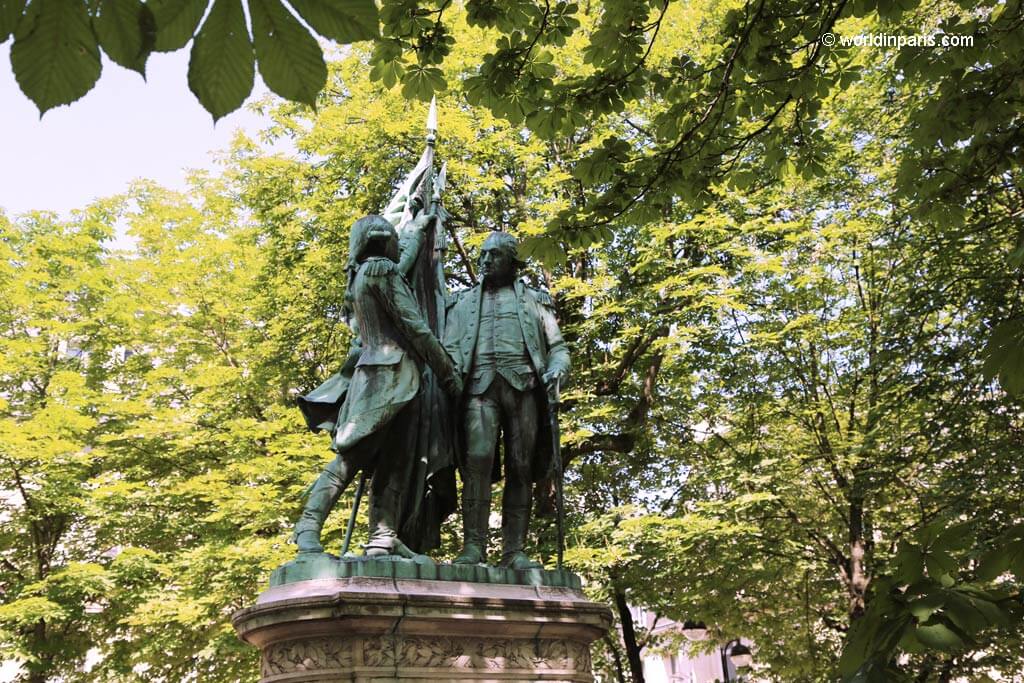
Located at Place des Etats-Unis, a place paying homage to our American friends, this sculptural group represents Lafayette and Washington.
The bronze monument, the work of Auguste Bartholdi (1895), is a gift from the United States to France as a token of gratitude for the installation of the Statue of Liberty in New York.
Place des Etats-Unis was constructed in 1881 on the site of large water reservoirs, each containing 9,000 muids. These reservoirs were supplied with water from the Seine River and then pumped by the Chaillot pumps.
The square’s previous name was Place de Bitche, but the name was changed following the establishment of the United States legation (we can understand the change…).
In Place des Etats-Unis, we can many elements celebrating the Paris-America shared history:
- Thomas Jefferson Square
- The monument in honor of Horace Wells
- The bust of the American Ambassador Myron Timothy Herrick
- The monument to Lafayette and George Washington
- The monument to American volunteers of the First World War
- A plaque commemorating the September 11, 2001 attacks.
Want to discover more chapters of American history in Paris?
Place des États-Unis also houses the Embassy of Bahrain and Kuwait, the headquarters of Maison Baccarat – with its Gallery-Museum – and the headquarters of Pernod-Ricard.

The Statue of Liberty in Paris
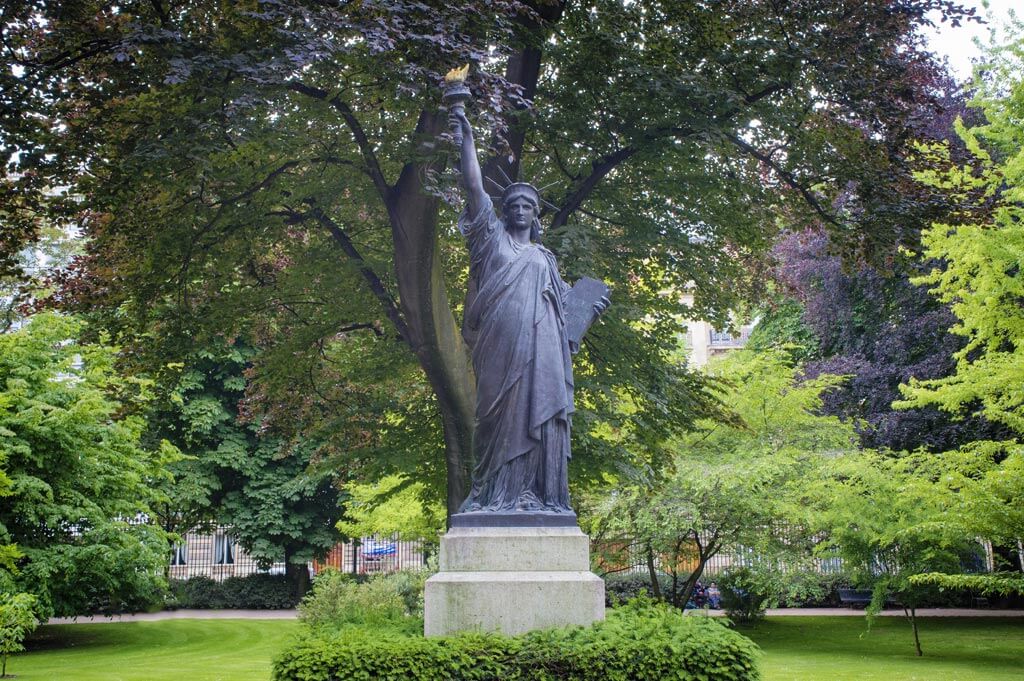
The Statue of Liberty in New York City was a gift to America from France to commemorate the centenary of the American Independence of 1776. It was designed by the French sculptor Auguste Bartholdi.
In turn, the American community in Paris gave a quarter-size Statue of Liberty to commemorate the centennial of the French Revolution, with the dates “IV Juillet 1776 – XIV Juillet 1789” inscribed on the Statue’s tablet. This Statue of Liberty is located on Île aux Cygnes, in Paris 15-16.
Paris has many other replicas cast from Bartholdi’s original model. Click here for the complete list of Statues of Liberty in Paris.
From Benjamin Franklin’s arrival in 1776 to the Treaty of Paris in 1783, these sites trace the history of the Founding Fathers in Paris and are a reminder of the shared connections between our two nations.
Ready to explore? Read my Paris trip planner or book a travel consultation to create a Founding Fathers itinerary tailored to your interests.